Study Guide
Context: why this pamphlet, why 1916
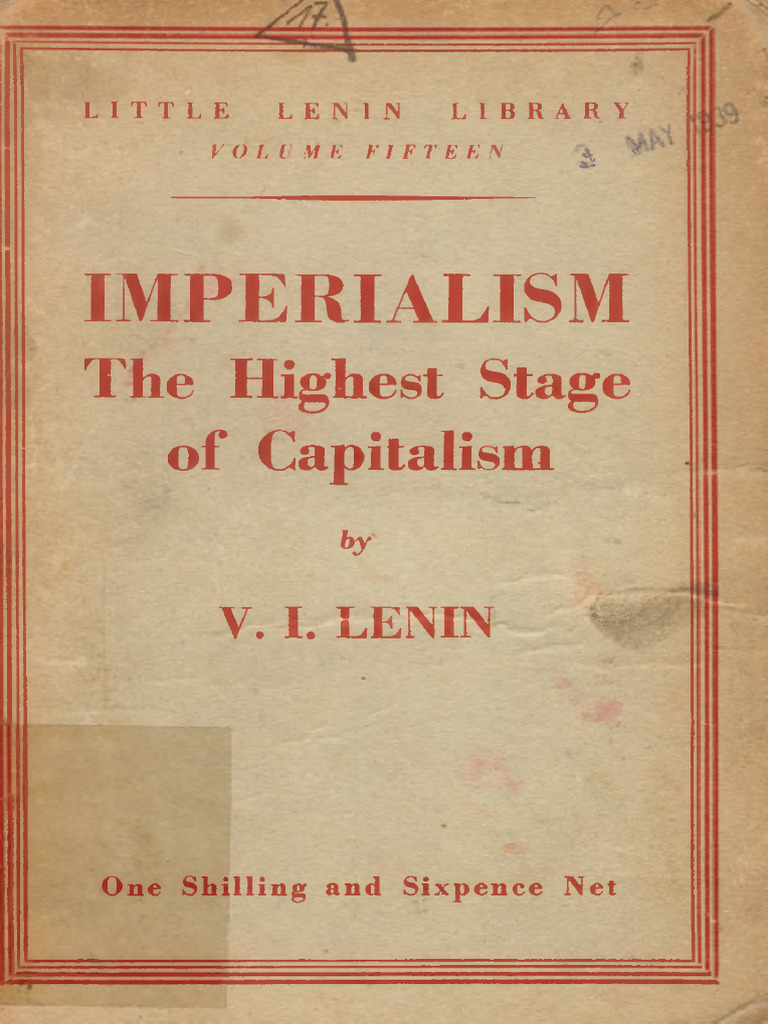
Lenin wrote Imperialism in Zurich in the first half of 1916 to explain why the world war was not an accident but the product of capitalism’s development. It was published in Petrograd in mid-1917, after the February Revolution.
The political problem it answers. In August 1914 most parties of the Second International voted war credits for their own governments. Lenin needed to explain two things at once: why the great powers were fighting, and why so much of the socialist movement had lined up behind them. The pamphlet answers the first directly and gestures at the second through the concept of the labor aristocracy.
Written under censorship. Lenin subtitled it “A Popular Outline” and wrote with an eye on the tsarist censor. His 1920 preface says he had to use “slavish” Aesopian language, citing Japan and Korea where he meant Russia and its own annexations. Read the political conclusions as deliberately understated; the sharper versions are in his other 1915–1916 writings.
What it synthesizes. Most of the empirical material is borrowed and Lenin says so openly. His main sources:
- J.A. Hobson, Imperialism: A Study (1902): a British liberal who tied empire to underconsumption and surplus capital seeking outlets abroad.
- Rudolf Hilferding, Finance Capital (1910): the Austro-Marxist account of banks merging with industry, which Lenin calls a valuable theoretical analysis while faulting its politics.
- Nikolai Bukharin, Imperialism and World Economy (written 1915): Lenin wrote a preface for it; the two books are best read together.
- German and French economic statistics, cartel reports, and bank data. The Notebooks on Imperialism (Collected Works vol. 39) hold roughly 800 pages of his raw research.
How to read it. The book is short (about 130 pages) and mostly descriptive. The theory sits in three places: chapter I’s claim that competition produces monopoly, chapter VII’s definition, and chapters VIII–X on parasitism, the labor aristocracy, and Kautsky. Read those slowly and skim the statistical tables.
The core argument
Imperialism is not a policy a government chooses; it is a stage of capitalism in which monopoly has replaced free competition. From that premise the war follows as the violent redivision of a world already fully divided.
The chain of reasoning runs like this:
- Competition concentrates production until, past a certain point, it produces monopoly: cartels, syndicates, trusts.
- Banks concentrate in parallel and stop being mere intermediaries. They become the controllers of industrial capital.
- Bank and industrial capital fuse into finance capital, run by a narrow financial oligarchy.
- Monopoly profits in the advanced countries produce a surplus of capital that cannot be invested profitably at home, so capital export becomes more important than commodity export.
- Monopoly combines divided world markets among themselves by agreement.
- The great powers finish dividing the world’s territory. By around 1900 almost no “unclaimed” land remains.
- Capitalism develops unevenly, so the balance of strength keeps shifting while the division stays fixed. A rising power (Germany) can only get its share by taking someone else’s. Hence war.
- Superprofits from abroad let the ruling class buy off an upper layer of workers, the labor aristocracy, which is the social base of opportunism in the workers’ movement.
- Monopoly makes capitalism parasitic and decaying (rentier states, coupon-clippers), and it socializes production so far that it is “moribund” — the eve of socialist revolution.
What to ask of it today
- Concentration of production and capital so high that it creates monopolies decisive in economic life. Are today’s giants monopolies in Lenin’s sense, or oligopolies that still compete fiercely?
- There’s been a merger of bank capital with industrial capital into finance capital and a financial oligarchy. Does finance still direct industry, or has it detached into its own circuits?
- Export of capital, as distinct from commodities, becomes exceptionally important. FDI now flows mostly between rich countries. Does that break the thesis?
- International monopolists combine and share the world among themselves. Are there cartels dividing world markets, or global value chains?
- The territorial division of the world among the biggest powers is complete. After decolonization, what replaces territorial control?
The book has ten chapters plus two prefaces. Chapters I–VI build the economics; VII defines; VIII–X draw the political conclusions.
Prefaces (1917 and 1920).
The 1917 preface explains the censorship. The 1920 preface, written for French and German editions, is the most openly political part of the book: it restates that imperialist war is inevitable under monopoly capitalism and attacks the Second International’s leaders by name. Read it last, not first.
I. Concentration of Production and Monopolies.
The foundational claim: free competition, by its own logic, generates concentration and then monopoly. Evidence comes from German and US industrial censuses and the rise of cartels. Watch for the periodization: 1860s–70s as the peak of free competition, the 1873 crisis as the start of cartels, and the 1900–03 crisis as the point where they become the basis of economic life. Note also his claim that monopoly does not abolish competition but sits above it, intensifying crises.
II. Banks and Their New Role.
Banks go from modest middlemen to institutions that see and control the accounts of whole industries. Key mechanisms: current accounts, share-holding, and personal union, meaning bankers on industrial boards and industrialists on bank boards. Ask: is this a description of Germany specifically?
III. Finance Capital and the Financial Oligarchy.
Lenin quotes Hilferding’s definition of finance capital, then adds that the essential point is monopoly. Watch for the holding system (control of large capital through small stakes at the top of a pyramid), the profits of company promotion and share issue, and the separation of capital-ownership from capital’s use in production.
IV. Export of Capital.
Under free competition capitalism exported goods; under monopoly it exports capital. The “surplus” exists because agriculture and mass living standards lag, not because capital has literally nowhere to go at home. Note the table of foreign investment by Britain, France and Germany and where each invested.
V. Division of the World Among Capitalist Associations.
International cartels (electrical, oil, shipping, rail) carve up world markets. Lenin insists the division follows capital and strength, not any principle, so any agreement is temporary.
VI. Division of the World Among the Great Powers.
Territorial partition is complete; colonial policy now means redivision. Watch for his typology of semi-colonies and dependent countries (Persia, China, Turkey, Argentina, Portugal), which anticipates later dependency theory.
VII. Imperialism as a Special Stage of Capitalism.
The five-feature definition, plus the first round of the Kautsky polemic. Crucial passage on why imperialism is capitalism’s highest stage and why the “stage” framing matters politically.
VIII. Parasitism and Decay of Capitalism.
Monopoly weakens the drive to innovate; the rentier state lives off coupon-clipping; a whole stratum of society lives off investment income. Here the labor aristocracy argument appears, drawing on Engels’ letters about the British working class. Also watch the claim that decay coexists with faster growth overall — Lenin is not predicting stagnation.
IX. Critique of Imperialism.
A survey of bourgeois and “petty-bourgeois” critics, including Kautsky and Hobson, who oppose imperialism’s excesses while wanting to keep its basis. The key move: a critique that treats imperialism as a bad policy leads to reformism.
X. The Place of Imperialism in History.
Summary chapter. Imperialism is monopoly capitalism, parasitic or decaying capitalism, and moribund capitalism. The famous closing image: private economic relations are a shell that no longer fits its content and must be removed.
The Kautsky polemic
The real target of the book is Karl Kautsky, the International’s leading theorist. The economics are borrowed; the break with Kautsky is Lenin’s own, and it is where the political stakes live.
Kautsky’s position. Kautsky defined imperialism as the drive of industrial capitalist nations to annex agrarian regions. It was, for him, a policy that finance capital preferred but did not require. In a 1914 article he suggested that the powers might move from rivalry to a joint cartel, an “ultra-imperialism” exploiting the world together and peacefully.
Lenin’s objections.
- Definition. Imperialism grabs industrial regions too (Germany eyeing Belgium, France eyeing Lorraine). The drive is for territory as such, because the aim is to weaken rivals.
- Policy vs. stage. Treating imperialism as a policy implies that a different, better policy is possible within capitalism. That is the root of reformism and of “defending the fatherland”.
- Uneven development. Any cartel of powers is an alliance based on relative strength at one moment. Since strength shifts, every peaceful alliance is only a truce between wars. The two are forms of the same struggle.
- Abstraction. Ultra-imperialism may be conceivable in the abstract, but it draws attention away from the actual contradictions of the present.
Why it mattered in 1916. If imperialism is a policy, socialists can pressure governments to pursue peace and moderate aims. If it is a stage, the only exit is revolution, and support for one’s own government is betrayal. Kautsky’s center position had become the ideological cover for the International’s collapse.
Read with a critical eye. Lenin somewhat caricatures Kautsky, whose 1914 argument was speculative and hedged. Post-1945 US-led cooperation among capitalist powers is often cited as a partial vindication of Kautsky; the counter-argument is that it rested on a single hegemon and a common enemy, not on a stable cartel of equals.
Debates and critiques
The pamphlet became canonical, and after 1924 Stalinist orthodoxy froze it into a checklist. Reading it well means knowing where it sits among rival accounts and which claims have held up.
Classical contemporaries
| Thinker | Key text | Difference from Lenin |
|---|---|---|
| Rosa Luxemburg | The Accumulation of Capital (1913) | Roots imperialism in capital’s need for non-capitalist markets to realize surplus value; a realization problem, not surplus capital |
| Nikolai Bukharin | Imperialism and World Economy (1915) | Stronger on the fusion of monopoly capital with the state (“state capitalist trusts”) and on the world economy as a whole |
| Leon Trotsky | Results and Prospects (1906); later writings on uneven and combined development | Extends uneven development into combined development: backward countries fuse the most advanced forms with archaic ones, which grounds permanent revolution |
| Hilferding | Finance Capital (1910) | Same economics, opposite politics: finance capital’s organization could be taken over gradually via the state |
Later Marxist accounts
- Dependency and world-systems (Baran, Frank, Amin, Wallerstein): shift the focus to the extraction of surplus from the periphery and the development of underdevelopment.
- Bill Warren, Imperialism: Pioneer of Capitalism (1980): argues imperialism spread capitalist development, and that Lenin reversed Marx on this. A useful provocation.
- David Harvey, The New Imperialism (2003): accumulation by dispossession and the tension between the territorial logic of states and the capitalist logic of capital.
- Leo Panitch and Sam Gindin, The Making of Global Capitalism (2012): the US state as manager of global capitalism; inter-imperialist rivalry largely replaced by US-led integration. The strongest Kautsky-adjacent case.
- Alex Callinicos, Imperialism and Global Political Economy (2009): the “two logics” (economic and geopolitical competition) as a restatement of the Lenin–Bukharin tradition; rivalry persists, now with China.
- John Smith, Imperialism in the Twenty-First Century (2016), and Zak Cope, Divided World Divided Class (2012): global labor arbitrage and super-exploitation of Southern labor. Cope pushes the labor aristocracy thesis to cover most Northern workers, a claim heavily disputed on the left.
What has held up, what hasn’t
Held up:
The centrality of giant firms; the fusion of great-power politics with capital accumulation; uneven development as a source of conflict; the danger of treating imperialism as a detachable policy.
Contested:
- Capital export direction. Most foreign investment today moves between rich countries, not from North to South, which cuts against the “surplus capital to backward regions” picture.
- Bank dominance. Germany’s bank-led model was not universal; in the US and Britain, finance and industry related differently.
- Territory. Formal colonies are gone. The argument now turns on whether economic, military and financial dominance does the same work.
- Labor aristocracy. Lenin never gave it a precise size or mechanism. Critics note that opportunism has other sources (union bureaucracy, the electoral state, nationalism), and that the thesis can slide into writing off Northern workers. Lenin purposely overstated its importance to serve as a course correction in real time within his own movement.
- “Highest stage” and “moribund”. A century of growth since 1916 makes the eve-of-revolution framing the claim readers most often question. Defenders read “highest” as “latest” and “moribund” as a structural tendency, not a timetable.
Discussion questions
These move from comprehension to argument.
Comprehension
- Why does Lenin insist that monopoly grows out of competition rather than being imposed on it? What would change if monopoly were a political creation?
- What exactly makes capital “surplus” in chapter IV? Is it a lack of investment opportunities, or a lack of profitable ones given low mass consumption?
- Why does Lenin say a short definition is inadequate, and then give one anyway?
- How does uneven development turn a completed division of the world into a cause of war?
Argument
- Is Lenin’s case against Kautsky economic, political, or both? Could someone accept the economics and still reject the politics, as Hilferding did?
- Did the post-1945 order refute Lenin, vindicate Kautsky, or simply suspend inter-imperialist rivalry under one hegemon?
- How would you apply the five features to US–China rivalry? Which feature fits best, and which fits worst?
- Lenin says monopoly brings decay and faster growth. How can both be true?
Strategy
- What does the labor aristocracy thesis explain, and what does it risk? What evidence would confirm or refute it today?
- If imperialism is a stage and not a policy, what follows for antiwar organizing in the US now? Does “the main enemy is at home” still hold when the rival is also capitalist?
- How should socialists in an imperialist country relate to national liberation struggles led by non-socialist forces?
- Lenin wrote under censorship and let the conclusions stay implicit. Where in the text do you see him saying more than he says?
Schedule:
Session 1
- Prefaces through Chapter IV
Session 2
- Chapter V – End
Session 3:
- “The Myth of the Labor Aristocracy” part 1 — Charles Post
- “The Myth of the Labor Aristocracy” part 2 — Charles Post
- Lenin’s Imperialism: Monopoly Analysis by Anders Molander
- Lenin and Bukharin on imperialism By Phil Gasper
Read these articles for a capstone discussion in week 3.