Here’s an attempt to propose a united front that could allow most leftists in the Denver area to collaborate toward common goals.
This document does two things. First, it maps where DRS agrees and disagrees with the other organized currents we share ground with. Second, it proposes a united front platform — a set of concrete demands broad enough that every one of those currents could sign it without abandoning its own program.
The second task depends on the first. A united front built on papered-over disagreement collapses at the first hard question. A united front built on honestly mapped overlap can hold. Our own points of unity say united fronts should be “temporary, binding, and as broad as we can reach a consensus.” This is an attempt to find where that consensus actually sits.
Where we agree
Where we disagree
Practical assessment: the largest pool of radicalizing people in Denver sits inside DSA. Any united front that excludes them is a united front of a few hundred people. Their left wing is a real partner on concrete fights.
Where we agree
Where we disagree
Practical assessment: strong partner on anti-ICE work, Palestine, and police accountability. Coalition work will strain wherever a specific foreign conflict forces the campism question into the open — the platform below is designed to avoid forcing it. Historically, other organizations have struggled to collaborate with local branches, because they insist on calling the shots. They have been bad community members and uncooperative coalition members. If PSL could collaborate rather than dictate and undermine, we have some common ground that we could both benefit from.
Where we agree
Where we disagree
Practical assessment: closest to us doctrinally, furthest from us in organizational culture. Good faith coalition work is possible; joint recruitment terrain will be contested.
Where we agree
Where we disagree
Practical assessment: this is the case study that justifies the phrase in our preamble about leadership “entrenched in such a way that reform is either incredibly difficult or impossible.” Our preamble already commits us to setting individual grievances aside, so we will.
Where we agree
Where we disagree
Practical assessment: FRSO’s program is the most programmatically serious document in this landscape and the one most worth studying, including where we reject it.
Included for contrast only. The DNC is not a peer formation; it is the electoral apparatus of a capitalist party, a cross-class coalition funded substantially by capital, with no program membership, no discipline, and no theory of state power beyond winning office within the existing order. Its internal fights are about electoral positioning.
It is worth noting what this reveals: refusal of the Democratic Party is the single point of near-total consensus across this entire landscape. DRS, PSL, RCA, FRSO, and Firebrand all independently rule it out. DSA is the sole exception, and that exception is the primary line of division in the American left today.
1. Defense against immigration enforcement
2. Against political repression
3. Against the police and the carceral state
4. Labor
5. Social provision
6. Against oppression
7. Against war and empire
Note: this section is deliberately phrased as opposition to our own state’s conduct. It does not require any signatory to endorse or condemn any foreign government. Signatories disagree about the character of those governments and will continue to. The demand is on Washington.
8. Against the far right
9. Working-class political independence
Honesty about the limits is what makes the rest credible:
Is this a workable foundation for a united front? Reach out and let’s hash it out.
Why Mask Mandates in Socialist Spaces Must Center Disability Justice
by Freida Gogh
Introduction
I swear I must be a glutton for punishment. This is not a popular argument. It’s not one I’ve even heard anyone else make before. I’m making it because any time I’ve said anything about this issue publicly, I’ve had people come to me privately afterward and thank me for speaking up (both for raising the issue and for raising my voice).
I was planning to attend a conference this year with a masking mandate, and I was really frustrated. I wanted to attend, but I knew that communicating there would be a challenge at times. Crowds are already difficult for me; this would be navigating the sensory issues that masks create for me, now compounded by being hard-of-hearing. How should I navigate this issue without burning my already miniscule amount of social capital? Those of us in the disabled community are told to ask for accommodations. So I asked.
My request was met with silence. No reply. No acknowledgement that they’d even received my request. Maybe they didn’t hear me? A couple of weeks later, I commented on a social media post that mentioned the mask mandate, stating, “the masking requirement is making me rethink attending.” Immediately, I was attacked. Not by the event organizers of course, but by other prospective attendees. I had apparently struck a nerve, but why?
COVID is dangerous. Long COVID is a dangerous, but relatively rare complication. There is a risk of contracting it and that risk is higher in poorly-ventilated enclosed spaces with many people. Masks work. Transparent masks are not as effective as traditional n95’s. I’m not arguing against any one of those points. There’s an argument here that’s been silenced and it’s worth discussing.
A note on usage: I use capital-D Deaf for the cultural and linguistic community, and “hard of hearing” for those of us with partial hearing loss who live mostly in the hearing world. I avoid “hearing impaired,” which frames us as broken versions of hearing people.
I. Together Or Not At All
Socialist organizing is built on a foundational commitment: that the liberation of all requires the centering of the most marginalized. We do not accept policies that treat some comrades as acceptable casualties of others’ comfort. We do not allow the majority to externalize its costs onto the vulnerable. These are not controversial principles in our movement; they are central to it.
What does it mean to center the marginalized? First, we attempt to level the playing field. If a comrade has difficulty climbing stairs, we provide ramps. If they are blind, we provide screen-reader compatible and audio versions of our materials. If they are Deaf, we provide interpreters. If they do not speak English, we provide translation. If they are immunocompromised, we provide masks and air filtration indoors.
But what do we do when the adaptation for one group makes it harder for another group to be there at all? We don’t all close our eyes in solidarity with blind comrades. We don’t all stop and carry wheelchair users up the stairs, though we would if there were no ramp. We don’t deliver every speech twice in two languages, though we do occasionally for short segments.
As a hard-of-hearing neurodivergent person, I’m asking you to set your defensiveness aside for a few pages. Do blanket mask mandates at leftist events live up to our principles of inclusion? I don’t think they do.
I want to be precise about what kind of disagreement this is, because it is not disabled comrades on one side and a healthy majority on the other. Immunocompromised comrades are disabled comrades. This is a conflict among us, between access needs that genuinely collide, and it has no clean resolution. What it has instead is a process, and that process has failed.
A mask requirement imposed without robust accommodations, without transparent justification, and without input from the range of disabled comrades it affects fails on three grounds. First, it is materially ableist, imposing concrete communicative and sensory harm on Deaf, hard-of-hearing, and neurodivergent attendees. Second, it rests on a thinner evidentiary foundation than its proponents typically acknowledge. Third, it corrodes the recognition and relationship-building that is the strongest remaining argument for gathering in person at all.
These are not right-wing arguments. They are disability justice arguments, materialist arguments, and they deserve to be heard on those terms.
II. How We Actually Hear
Some numbers first. Roughly 15% of American adults — 37.5 million people — report some trouble hearing. About 5% of adults aged 45–54 have disabling hearing loss; 10% of those 55–64; 22% of those 65–74; and 55% of those 75 and older. Among adults 70 and older who could benefit from hearing aids, fewer than one in three has ever used them. Among adults 20–69, it’s about one in six.
Look around your next branch meeting and do the math.
Speech perception is primarily auditory, but it is intrinsically multimodal. Speech relies on the movements of the mouth, on facial expression, and on context to carry its full meaning. This is why sign language interpreters often mouth and over-enunciate the words they are signing: more channels, more redundancy, more comprehension.
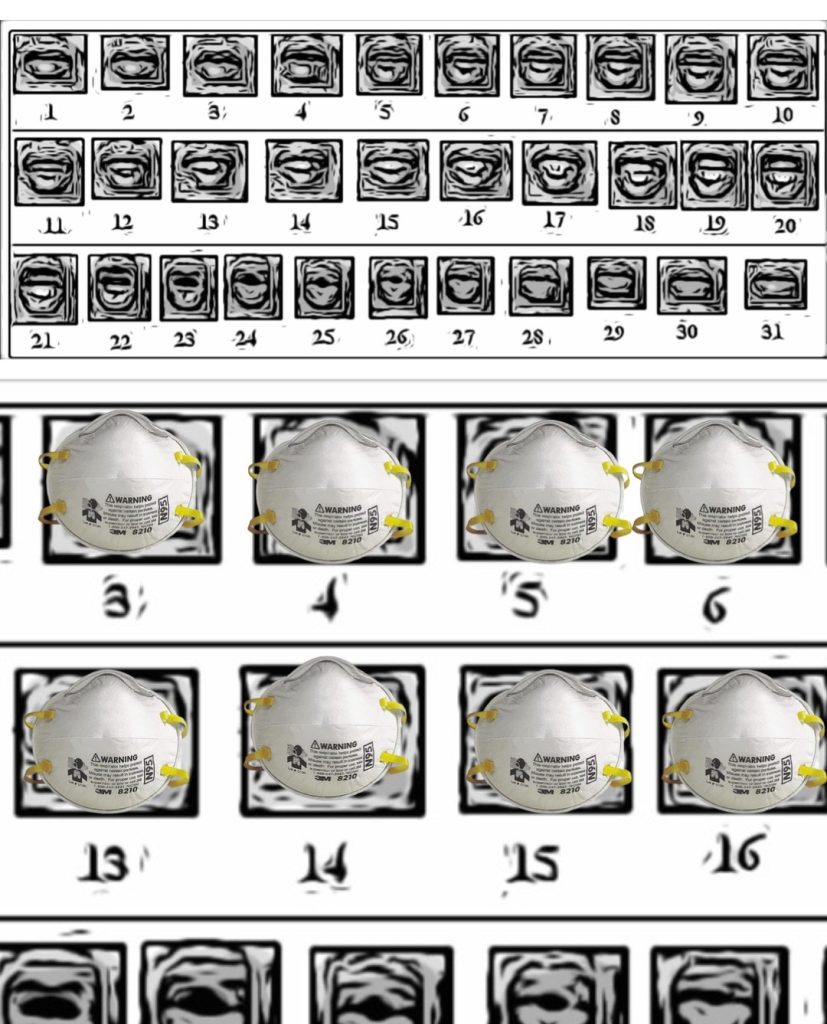
We break language into phonemes and visemes. Phonemes are sounds. Visemes are the visually distinct mouth shapes that produce them. English has 44 phonemes but far fewer visemes, because many sounds are differentiated inside the nose, throat, and tongue where you cannot see them. This is the ambiguity children exploit when they mouth “elephant shoes” to mean “I love you.”
Which is why pure lip-reading gets you no more than about a third of what’s said. But hard-of-hearing people aren’t purely lip-reading. We’re assembling a composite: the visemes we can see, the phonemes we can still hear, facial expression, body language, context, the slide behind the speaker. Each channel corroborates the others. Remove one and the rest have to carry more than they can.
Does obscuring the face meaningfully disadvantage hard-of-hearing people in our spaces? Are we choosing our disadvantage over that of the immunocompromised? Does the risk of respiratory illness outweigh the cost of not being able to understand each other? I don’t have clean answers to these questions. What frustrates me is that nobody is asking them.
III. The Disability Justice Framework
It is worth establishing what kind of argument this is, because it will be misread. Opposition to mask mandates has become a marker of right-wing politics: denialism, individualism, hostility to public health. This piece may share a conclusion with that tradition and nothing else.
The critique here is grounded in disability justice as developed by organizers including Mia Mingus and the collective Sins Invalid: that disabled people must not be an afterthought in movement spaces, that accessibility is not a favor but a floor, and that no policy is neutral. The question is always who bears its costs.
Disability justice asks us to move past what Mike Oliver called the charity model — in which a non-disabled majority graciously accommodates disabled people when convenient — toward genuine co-creation of spaces. Applied here, the question is not “can we accommodate Deaf and neurodivergent attendees under our mask policy” but “were Deaf and neurodivergent comrades in the room when this policy was written?”
The answer, in most cases, is no. These policies have generally been adopted by processes dominated by non-disabled voices, or by immunocompromised voices alone, framed as unambiguous collective care, and treated as beyond critique. And where hearing loss is considered at all, it is considered only for the Deaf and nearly deaf, not for the far larger group with partial loss who manage fine in daily life and are lost the moment a room fills with masked, echoing voices.
That is not disability justice, but a performance of it.
IV. What It Costs Deaf and Hard-of-Hearing Comrades
At a multi-day conference built on panels, workshops, caucuses, and hallway conversations, losing the visual channel is not just inconvenient, but can amount to exclusion from participation, distributed across every hour of the event.
The harm compounds for signers. Facial expression is not decoration in ASL; it is grammatically constitutive. Facial behaviors encode negation, questions, topic markers, aspect, and intensifiers. They are not an emotional overlay on top of signs but part of the morphosyntactic system itself. A masked environment doesn’t make signing harder. It makes it linguistically incomplete, in a way that has no analog in the hearing experience of masking.
The obvious reply is: provide captioning and interpreters. We should, always, and more than we currently do. But be honest about what that fixes. CART (communication access realtime translation) covers the plenary. It does not cover the hallway, the smoke break, the caucus that spills into a stairwell, the conversation over coffee where you find out who’s actually doing the work on a campaign you’ve been following. It does not cover the moment someone leans in and says something they wouldn’t say from a microphone.
Captioning gets a Deaf or hard-of-hearing comrade the content of the conference. It does not get them the conference.
When we build a space where comrades cannot fully follow a panel, cannot fully participate in a workshop, and cannot hold a complete conversation in the hall, we have built a space that is not for them. We have told them, through policy, that their presence matters less than the majority’s sense of safety. That is ableism. It does not become something else because we meant well.
V. What It Costs Neurodivergent Comrades
These harms are less visible, which makes them easier to dismiss and more important to name.
For many autistic people, prolonged mask-wearing involves real sensory processing difficulty. A 2022 multisite study found that pre-existing sensory-seeking traits predicted both difficulty wearing masks and impaired social communication among autistic children and adolescents. A 2024 qualitative study of autistic adults found that wearing masks and interacting with masked people created compounding difficulties across sensory, emotional, and communicative dimensions.
This confirms what autistic self-advocates said throughout the pandemic. The texture, the pressure, the heat, the altered breathing, these are not minor discomforts to be managed with willpower. For some people they make sustained presence in a room genuinely painful and eventually impossible.
And masking strips facial information from an environment where many neurodivergent comrades are already working harder than their peers to read the room. A multi-day conference is cognitively expensive under the best conditions. Obscuring faces removes supports people have spent years learning to use.
A mask exemption process addresses none of this. It requires a comrade to out themselves, justify their needs to an authority, and navigate a bureaucracy while already managing the demands of attendance. An exemption is not an accommodation. It is an obstacle installed to placate critics. It further stigmatizes the exempt attendees, rather than making them feel welcome.
Is that collective care?
VI. What Masks Do (and Don’t Do)
The COVID landscape keeps moving, and we should move with it. Rather than print numbers that will be stale before this zine is stapled, I’d point you to the CDC’s Respiratory Illnesses Data Channel and ask you to check it yourself before your next event.
I’ll name the awkward part directly: as I write, a summer wave is building. Cases are climbing. I am arguing for relaxing a policy while transmission rises, and I don’t want to slide past that.
Here is why I think it holds anyway. Severity is the variable that should govern policy, and severity is not tracking 2021. Hospitalization rates have fallen substantially from the earlier waves that produced our current norms. That does not mean COVID is over. It means the threat model has changed, and a policy written for the acute emergency of 2021 should not still be running on autopilot in 2026. As socialists, when the material conditions change, our tactics should adapt.
On the masks themselves: the meta-analytic evidence for respirator effectiveness comes overwhelmingly from healthcare settings with sustained exposure, trained users, fit-tested equipment, consistent wear. A conference hall is not a hospital ward. Marx, Engels, and Lenin would all fail a fit test on facial hair alone. Attendees pull masks down to eat, to drink, to be understood. Compliance is uneven by design. The conditions under which respirators demonstrably protect people do not describe a multi-day activist gathering.
I should also name the strongest argument on the other side, because it is a disability justice argument too: long COVID is disabling, and every infection is a chance to create new disability. That is real, and it is why “just let people choose” is not a sufficient answer. But it argues for reducing transmission through ventilation, air quality, and spatial design not specifically for the one intervention that works least well in this setting and costs the most to a different group of disabled comrades.
None of this means COVID isn’t real, that risk is zero, or that vulnerable comrades have no legitimate interest in protection. It means the blanket mandate has not been shown to deliver what its proponents assume in this specific context, and that this matters enormously when it imposes documented harm on other disabled comrades.
VII. Why We Bother Gathering At All
There is a third cost, and it’s the one I think we’ve been least willing to look at.
We can hold panels on Zoom. We can share documents, run trainings, take votes, and argue about the line without anyone buying a plane ticket. What we cannot do remotely is the thing that makes an in-person convention worth its enormous cost: recognizing each other. Knowing faces. Building the accumulated familiarity that lets a community notice who has been around, who vouches for whom, and who is new and needs to be brought into the fold. That recognition is the substrate of every trust network we have, and it is built by seeing people over time.
A conference where nobody can see anyone’s face is a Zoom call you paid airfare for. If we’ve decided that the in-person gathering is worth the money, the carbon, and the days away from work, then we should be honest that we’re stripping out most of what we came for.
VIII. A Path Forward
None of the foregoing is an argument against caring about transmission, supporting immunocompromised comrades, or taking collective health seriously. It is an argument against one policy instrument.
X. Conclusion
A conference that tells Deaf comrades they cannot fully participate, and tells neurodivergent comrades their sensory needs are secondary, is reproducing the hierarchies it exists to oppose.
This debate will be uncomfortable. It will be misread by some as an attack on collective care. It should be received as something else: as a demand that collective care be real, that it accounts for all of us, and that we hold our own policies to the same materialist standard we apply to everything else.
We can do better than this, and we owe each other the attempt.
Further Reading
Auer, Edward T., and Lynne E. Bernstein. “Enhanced Visual Speech Perception in Individuals with Early-Onset Hearing Impairment.” Journal of Speech, Language, and Hearing Research 50, no. 5 (2007): 1157–1165.
Clegg, Anna, Jade Wood, Hannah Hobson, and Felicity Sedgewick. “The Experiences of Autistic People When Facemask Wearing and Interacting with Masked Individuals.” Autism in Adulthood 6, no. 3 (2024): 285–296.
Graves, A. M., et al. “N95 Respirator and Surgical Mask Effectiveness Against Respiratory Viral Illnesses in the Healthcare Setting: A Systematic Review and Meta-Analysis.” Open Forum Infectious Diseases 11, no. 3 (2024): ofae040.
Mingus, Mia. “Access Intimacy: The Missing Link.” Leaving Evidence, May 5, 2011.
National Institute on Deafness and Other Communication Disorders. “Quick Statistics About Hearing, Balance, & Dizziness.”
Oliver, Mike, and Colin Barnes. The New Politics of Disablement. Basingstoke: Palgrave Macmillan, 2012.
Sins Invalid. Skin, Tooth, and Bone: The Basis of Movement is Our People — A Disability Justice Primer. 2nd ed. Berkeley: Sins Invalid, 2019.
Tamon, Hiroki, et al. “Autistic Children and Adolescents with Frequent Restricted Interest and Repetitive Behavior Showed More Difficulty in Social Cognition During Mask-Wearing During the COVID-19 Pandemic: A Multisite Survey.” BMC Psychiatry 22, no. 1 (2022): 607.
Valli, Clayton, Ceil Lucas, Kristin J. Mulrooney, and Miako Villanueva. Linguistics of American Sign Language: An Introduction. 5th ed. Washington, DC: Gallaudet University Press, 2011.
U.S. Centers for Disease Control and Prevention. Respiratory Illnesses Data Channel. cdc.gov/respiratory-viruses/data
FAQ:
Q: Presenters don’t have to wear masks. What’s the big deal?
A: Presenters unmasking helps, and it’s better than nothing. But a conference isn’t a series of speeches. It’s the Q&A, the workshop where twelve people talk over each other, the caucus that spills into a stairwell, the smoke break where you find out about what’s working in other cities. If the presentations were the point, we’d have stayed on Zoom and saved the airfare.
Q: ASL translation is an accommodation that doesn’t conflict with masking.
A: Most of the hard-of-hearing community isn’t Deaf and doesn’t know sign language. Interpretation is essential and we should provide more of it. But it serves Deaf comrades, and most people with hearing loss aren’t Deaf and don’t sign. Roughly 15% of American adults report some trouble hearing; most manage fine in daily life, don’t identify as disabled, and would never think to request an interpreter. We’re the ones who quietly lose half of what’s said in a masked room and don’t say anything. Interpretation doesn’t reach us. That’s most of the affected population.
Q: Don’t clear masks fit and filter worse? Independent testing shows it.
A: It’s true. Clear masks where communicative benefit is highest, not universally, and paired with ventilation that lowers the stakes of the fit penalty. This is a real tradeoff.
Q: Long COVID can disable anyone. This protects you too.
A: Yes, it’s real and it’s a disability justice argument. However, the number in circulation predates vaccines and Omicron. It’s a risk and should be mitigated. It’s also not the only risk that should be weighed in these discussions.
Q: Isn’t prioritizing your access needs over the collective’s health individualist?
A: Immunocompromised, neurodivergent, and hard-of-hearing comrades all part of the collective. Defining the collective as “everyone-but-you” is how ableism has always worked.
Q: “You don’t advocate for clean air, far-UVC, or testing.
A: I do, and it’s most of what I’m asking for. Ventilation standards. CO₂ monitoring. Outdoor and high-ventilation space. Venue selection on air quality. My complaint isn’t that we’re doing too much about transmission, it’s that we’ve reached for the one measure that costs disabled comrades the most and done almost nothing about the building.
Q; Doesn’t this hand ammunition to the right?
A: Yes, someone will misquote me, but that’s not a sufficient reason for the left to refuse to examine its own policies. Our arguments are sounder when they’re stress tested among allies.
Q: Have you considered that you might be wrong?
A: About epidemiology, entirely possible. I’m a carpenter and an organizer, not an epidemiologist, and the evidence on masking in community settings is contested rather than settled in my favor. But the argument I’m actually making doesn’t depend on winning that. Even if masks work exactly as well as their strongest advocates claim, I asked for an accommodation through the proper channel and got no reply, not a denial, silence. That happened regardless of what the science says, and it’s what I most want changed.
Q: So what do you actually want?
A: I want people like me to be included and considered when we’re deciding policies that affect people like me, in our gatherings, in our workplaces, and in our government.
There’s this moral issue called the hostage-taker’s veto. It’s a situation where an individual or group uses their power to block decisions or actions in order to extract concessions from others, often in a political context like this one. This strategy can involve leveraging veto power in negotiations to gain advantages in unrelated areas. It came up this week in response to GEO Group workers punishing detainees for protests happening outside the facility. Should we stop protesting to prevent further harm?
Once we let the threat of retaliation against the detainees govern whether we apply pressure or not, we are handing GEO a switch where they can turn our action off or on at their whim by mistreating our people. If we back off when they retaliate, we are teaching them that hurting detainees is effective. This doesn’t protect detainees long-term, only perhaps in the short-term.
However, responsibility for this mistreatment lies entirely with GEO and ICE. I refuse to grant them a veto by treating their threats as binding, and I refuse to take any responsibility for their retaliation.
What I wasn’t factoring into the situation is that we’re not sufficiently embedded within the community to be able to speak or choose for them. This is at the heart of my hesitancy with our overall tactics against ICE; acting on their behalf without their consent is substitutionism, and not a good way to structure a movement. If there were stronger voices of self-organization that had something approaching a mandate from a majority, it would be different.
The people with standing to weigh the retaliation are the detainees themselves, so the task isn’t “decide for them” or “defer to their imagined wishes,” it’s build the channel that lets their actual preferences drive it.
Where does that leave us on the issue? I’m interested to hear what you all think. I don’t think that tactically cowing to abuse is going to work out, but that’s not really what anyone’s advocating for. I also don’t think we can choose for detainees, but I’m also not going to wait to put pressure on GEO until self-organization develops among detainees.
What could accomplish both purposes right now is building infrastructure of resistance through commissary, legal, family contact, and building actual relationships if they want them. We offer it and follow through whether or not they want us pressuring GEO in other ways.
Will they want to have those relationships or solidarity with us though? We have to acknowledge that the mindset of the radical organizer is very different from most of the people that we’re fighting “for” in this. Do these people want our solidarity even though we may only share a common enemy? I believe they will, but that’s something I’m weighing in how to approach the issue.
by Freida Gogh
“Individual terror is inadmissible precisely because it belittles the role of the masses in their own consciousness. It reconciles them to their powerlessness and turns their eyes and hopes toward a great adventurer and liberator who someday will come and accomplish his mission.” — Leon Trotsky
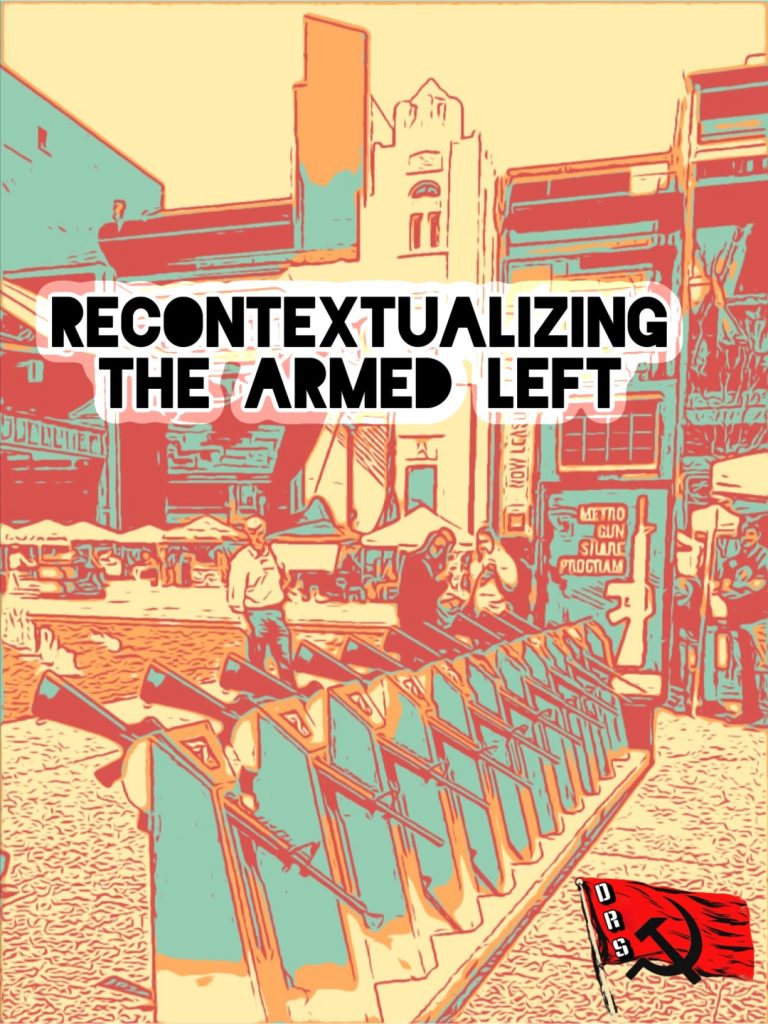
Tyler is a comrade. We have organized together, argued together, and I have a great deal of respect for the political seriousness he brings to these questions. It is precisely because of that respect that I want to engage his recent video on leftists and firearms carefully and on the record, because I think he has made a significant analytical error that, left unchallenged, forecloses a genuine site of working-class struggle.
Tyler’s argument is built on a conflation that does most of his work for him before the analysis begins. By opening with individual acts of violence, the Luigi Mangione case, Willem Van Spronsen’s attack on the ICE facility in Tacoma, and then moving without pause through armed affinity groups and militia formations to gun ownership and firearms training broadly, he treats these as variations on a single political problem. They are not. Individual acts of targeted violence, organized armed community defense, and the project of building a firearms-literate working-class left are three distinct phenomena with distinct histories, distinct organizational logics, and distinct political implications. Collapsing them allows Tyler to use the most indefensible case, the lone actor, to contaminate the others by association.
This is not a minor rhetorical slippage. It is the load-bearing move in his argument. Remove it, and most of what follows doesn’t hold.
The conflation runs in two directions. First, as noted, individual terror gets smuggled into a critique of organized armed defense. But second, and this is the more consequential error, Tyler’s entire framework treats the state as the only threat worth analyzing. The right-wing militia movement, the organized street violence of fascist formations, the targeted assassination of activists: these are functionally invisible in his account. When the only armed threat you’re theorizing is the state, then yes, the asymmetry is so total that armed resistance looks like a fantasy. But that is not the threat environment the left actually operates in. Heather Heyer was not killed by the state. The organizers murdered by the Ku Klux Klan during the civil rights movement were not killed by the state. The question of whether leftists should be armed cannot be seriously engaged without accounting for the armed right as a material force in our political life.
Tyler is not wrong to look to history here, and his reading of Fred Hampton is genuinely sharp. But the historical record he’s drawing on is incomplete in ways that matter. The Panthers are not the only, or even the most instructive, example of organized armed self-defense in the American left tradition.
Robert F. Williams was the president of the Monroe, North Carolina NAACP chapter in the late 1950s when he organized armed self-defense against Klan terror. His account of that experience, Negroes with Guns, documents something Tyler’s framework cannot explain: that organized, visible, community-based armed defense did not substitute for political organizing but enabled it. When the Klan knew that Black neighborhoods in Monroe were armed and prepared to defend themselves, the calculus of terror changed. Williams was not launching clandestine guerrilla raids against the state; he was protecting the conditions under which his community could organize, meet, and build power without being murdered for it. The NRA, it is worth noting, even supported his chapter’s right to bear arms before they understood what he intended to do with it.
The Deacons for Defense and Justice, formed in Jonesboro, Louisiana in 1964, represent the organizational maturation of this tradition. This Non-Violent Stuff’ll Get You Killed tells the history of The Deacons were explicitly working-class, rooted in the industrial workforce of the rural South, and their purpose was unambiguous: to protect civil rights organizers and Black communities from Klan violence at a moment when the state not only refused that protection but actively participated in the terror. They were not an armed vanguard pursuing revolutionary objectives. They were a disciplined community defense organization that made it possible for CORE organizers to work in areas where they would otherwise have been killed. Historians of the period are fairly consistent that Klan activity decreased measurably in areas where the Deacons operated. On a side note, I have taught from both of these books within the SRA.
Tyler’s Panthers analysis is stronger than his treatment of these earlier examples, and his point about Hampton is well taken. But it cuts differently than he intends. The state did not assassinate Fred Hampton because he was armed; it assassinated him because he was building the kind of cross-sectional working-class solidarity that makes armed defense viable and meaningful. The guns were not the threat. The organization was the threat. That distinction, which Tyler identifies correctly and then abandons, is precisely the one that should be guiding this entire debate.
What the preceding account reveals is not a debate about firearms. It is a debate about history, strategy, and the organizational logics of the left, conducted, notably, with enough seriousness to reach principled resolutions. Tyler’s video implies that armed left organizing is the province of undisciplined adventurists with no political framework beyond the fantasy of individual heroism. The Socialist Rifle Association, in which I am currently a national-level organizer, is a direct refutation of that characterization.
The SRA is not simply a gun club. It is a multi-tendency organization that has functioned as a genuine site of left political struggle, and the debates it has hosted are as substantive as anything produced in the reading formations and journal articles that constitute the more respectable precincts of the organized left.
Consider the organization grappling with the question of military members joining the group. A determined faction within the SRA pushed to ban active-duty military members from joining, drawing on the same third-worldist logic that animates the broader left tendency to treat soldiers as imperial agents rather than workers. This is not an obscure theoretical position — it has deep roots in the Vietnam-era left’s encounter with Emmanuel Arghiri’s unequal exchange theory, Baran and Sweezy’s Monopoly Capital, and a reading of Fanon that produced what I’ve elsewhere called vanguardism without a class. The position treats soldiers’ structural location within the imperial military apparatus as definitive of their class interests, collapsing the distinction between the institution and the people compelled by economic circumstance to serve in it.
The counter-argument, which ultimately prevailed in a democratic referendum after extended debate, drew on Charles Post’s updating of Lenin’s labor aristocracy thesis. Post’s work in Against the Current demonstrates that the labor aristocracy argument, properly understood, does not support the wholesale exclusion of any sector of the working class from solidarity, and that Lenin himself, whose positions are often cited in support of third-worldist exclusions, was frequently leaning into certain tendencies harder than his actual line in order to correct over-represented errors among the masses. His opposition to economism in What Is To Be Done? is a clear example: a polemical overcorrection that gets read as a settled position. The referendum result was not a victory for political softness. It was a victory for rigorous class analysis over inherited cultural norms dressed up as theory. We’re not angry punks training to be antifa supersoldiers. We are principled revolutionaries who are training, building relationships, and developing our political positions.
We recently had a very contentious fight over governance and our bylaws that were a different kind of education. What the SRA experienced at the national level was a masterclass in how a determined faction, operating with discipline and clear objectives, can use procedural control to capture an organization whose silent center — people who joined to build working-class community around a shared practice — has no comparable organizational focus. We witnessed the building of voting blocs, the exploitation of poorly-written bylaws, the mechanisms of regulatory capture applied to a grassroots left organization. We learned, at some cost, what it takes to counter that kind of maneuvering without becoming it. That is not adventurism. That is politics. That is the kind of mass work that builds cadre.
The debates around class reductionism and identity politics were the most directly relevant to the broader left context in which Tyler and I both operate. The SRA’s membership spans tendencies that disagree sharply on these questions — anarchists, various Marxist formations, people with no prior organizational affiliation whose politics were shaped by the gun range rather than the reading group. The argument I brought to the organization, drawing on Asad Haider’s Mistaken Identity, is that identity politics as practiced on the American left has become a demobilizing and divisive force not because the underlying questions of race, gender, and oppression are illegitimate, but because the substitution of identity-based frameworks for class analysis produces organizations that are very good at policing their own membership and very bad at building power. Haider’s concept of insurgent universality, the idea that particular struggles become politically generative when they reach toward a universality that includes rather than excludes, offers a way out of the binary between class reductionism and identitarian fragmentation that has paralyzed so much of the left.
This argument landed differently in the SRA than it would have in a reading group or a socialist convention. It landed in a room where the people disagreeing with me had guns, had training, and had made a material commitment to the project of working-class self-defense. That changes the stakes of the argument in ways that are clarifying rather than distorting.
None of this is incidental to the question Tyler is asking. It is the answer to it. The SRA is evidence that firearms-centered organizing does not produce the depoliticized, tactically confused, individually-oriented gun culture Tyler critiques. It produces something closer to what the left actually needs: a durable organizational infrastructure built around shared practice, capable of holding serious political disagreement, and reaching people who will never feel welcome in typical leftist spaces.
This brings me to what I think is the most significant gap in Tyler’s argument, and the one most worth addressing seriously. His critique of armed organizing assumes a specific kind of left subject: politically educated, organizationally experienced, comfortable in the deliberative culture of the socialist left. That subject exists. But they are not the whole of the working class, or even the most important part of it for the project of building a mass movement.
There is a substantial stratum of working-class people in this country for whom the gun range is a more natural organizing terrain than the reading group or the protest. They are not politically unsophisticated, they are politically differently situated. They distrust institutions, including left institutions, for reasons that are materially grounded. They have skills, networks, and community relationships that the organized left cannot access through its existing channels. And they are already organized, around gun culture, around hunting and sport shooting communities, around a set of practices and social bonds that the left has largely ceded to the right by treating firearms as inherently reactionary.
Firearms training as a base-building site reaches this stratum. It offers a point of entry that does not require prior political formation, does not demand fluency in left theoretical vocabulary, and does not sort people by their comfort with the deliberative culture of socialist organizations. What it does require is showing up, developing skill, and building trust with the people next to you, which is, not coincidentally, the same foundation on which every durable political organization has ever been built.
The political education follows from the practice rather than preceding it. This is not a concession to anti-intellectualism. It is a recognition that most people’s political consciousness develops through material engagement with the world, through the experience of collective action, through the relationships formed in the process of doing something together, not through exposure to correct theory delivered in advance of any organizing relationship. The union hall model worked not because workers arrived already convinced of the need for collective bargaining, but because the experience of organizing together produced that conviction. A firearms training community that develops political consciousness through practice is doing the same thing on different terrain.
Is this just a lifestyle politics trap then? Is this an example of well-armed, politically educated people who are not building toward anything specific and have simply found a more interesting hobby? In short, no, because it brings us to the question of preparedness.
The argument is not that firearms training is a substitute for mass movement building. It is that mass movements, at certain stages of political development and under certain conditions of repression, require people who can operate as disciplined units rather than as individuals who happen to be armed. The difference between an armed population and an organized armed force is not primarily a question of weapons, it is arguably more a question of trust, coordination, shared doctrine, and practiced unit cohesion. These things cannot be improvised in a moment of crisis. They are built over time, through repeated shared practice, through the experience of working through disagreement and emerging with functioning relationships on the other side.
The American left, if it ever reaches the point where armed defense of communities or organized resistance to state or fascist violence becomes a practical necessity rather than a theoretical question, will not be starting from zero in the organizations that have been doing this work. That is not a fantasy of revolution. It is an application of basic organizational logic to a question Tyler’s framework refuses to take seriously on its own terms.
The Deacons for Defense did not emerge from nowhere. Robert F. Williams did not pick up a gun and immediately become an effective organizer of armed community defense. These formations were built over time, through practice, through the development of relationships and trust and shared political understanding. The question is not whether we will need that infrastructure. The question is whether we are building it now, before we need it, or whether we will find ourselves improvising under conditions that do not permit improvisation.
Which brings us back to where we started.
Trotsky’s condemnation of individual terror is correct, and Tyler is right to invoke it. The lone actor who substitutes their own moral clarity for the organized power of the working class is not a revolutionary. They are, in Trotsky’s precise formulation, a symptom of the mass movement’s weakness rather than an expression of its strength. Luigi Mangione is not Fred Hampton. Willem Van Spronsen is not the Deacons for Defense. The conflation of these figures, which Tyler’s argument requires, is not a political analysis. It is a categorical error dressed as one.
But Trotsky’s critique cuts in only one direction. It is a critique of substitutionism, of the individual or small group that acts in place of the mass. It is not a critique of the mass developing the capacity to act. It is not a critique of organizations that build the human infrastructure of collective defense through shared practice. It is not a critique of working-class people developing the skills, relationships, and unit cohesion that make organized resistance possible. It is, if anything, an argument for exactly that kind of patient, disciplined, mass-oriented organizing, which is precisely what the SRA and organizations like it are doing.
The hammer Trotsky describes is a mass movement. The question of whether that movement needs to be armed, under what conditions, and how it develops the organizational capacity to act in a disciplined and effective way when those conditions arrive, these are tactical and strategic questions that serious revolutionaries have always engaged seriously. The American specificity of mass gun ownership, a heavily armed right-wing movement, a state that is simultaneously the most powerful apparatus of organized violence in human history and, at the local and street level, increasingly unable to protect working-class communities from right-wing terror — this context does not make the question go away. It makes it more urgent.
Tyler ends his lecture with a call to recognize the anger that drives people toward arms and harness it toward building working-class movements. I agree with him completely. Where we disagree is on whether firearms-centered organizing is a distraction from that project or one of its most promising available forms. The evidence of history, the evidence of the organizations that have done this work, and the evidence of what is actually happening inside the SRA suggest the latter.
We are not adventurists. We are not fantasists. We are not terrorists. We are not substituting the gun for the mass movement. We are building the mass movement, in the terrain available to us, with the people who show up. When the moment comes that requires more than that, we will not be starting from zero.
Come shoot with us and decide for yourself.