Why Mask Mandates in Socialist Spaces Must Center Disability Justice
by Freida Gogh
Introduction
I swear I must be a glutton for punishment. This is not a popular argument. It’s not one I’ve even heard anyone else make before. I’m making it because any time I’ve said anything about this issue publicly, I’ve had people come to me privately afterward and thank me for speaking up (both for raising the issue and for raising my voice).
I was planning to attend a conference this year with a masking mandate, and I was really frustrated. I wanted to attend, but I knew that communicating there would be a challenge at times. Crowds are already difficult for me; this would be navigating the sensory issues that masks create for me, now compounded by being hard-of-hearing. How should I navigate this issue without burning my already miniscule amount of social capital? Those of us in the disabled community are told to ask for accommodations. So I asked.
My request was met with silence. No reply. No acknowledgement that they’d even received my request. Maybe they didn’t hear me? A couple of weeks later, I commented on a social media post that mentioned the mask mandate, stating, “the masking requirement is making me rethink attending.” Immediately, I was attacked. Not by the event organizers of course, but by other prospective attendees. I had apparently struck a nerve, but why?
COVID is dangerous. Long COVID is a dangerous, but relatively rare complication. There is a risk of contracting it and that risk is higher in poorly-ventilated enclosed spaces with many people. Masks work. Transparent masks are not as effective as traditional n95’s. I’m not arguing against any one of those points. There’s an argument here that’s been silenced and it’s worth discussing.
A note on usage: I use capital-D Deaf for the cultural and linguistic community, and “hard of hearing” for those of us with partial hearing loss who live mostly in the hearing world. I avoid “hearing impaired,” which frames us as broken versions of hearing people.
I. Together Or Not At All
Socialist organizing is built on a foundational commitment: that the liberation of all requires the centering of the most marginalized. We do not accept policies that treat some comrades as acceptable casualties of others’ comfort. We do not allow the majority to externalize its costs onto the vulnerable. These are not controversial principles in our movement; they are central to it.
What does it mean to center the marginalized? First, we attempt to level the playing field. If a comrade has difficulty climbing stairs, we provide ramps. If they are blind, we provide screen-reader compatible and audio versions of our materials. If they are Deaf, we provide interpreters. If they do not speak English, we provide translation. If they are immunocompromised, we provide masks and air filtration indoors.
But what do we do when the adaptation for one group makes it harder for another group to be there at all? We don’t all close our eyes in solidarity with blind comrades. We don’t all stop and carry wheelchair users up the stairs, though we would if there were no ramp. We don’t deliver every speech twice in two languages, though we do occasionally for short segments.
As a hard-of-hearing neurodivergent person, I’m asking you to set your defensiveness aside for a few pages. Do blanket mask mandates at leftist events live up to our principles of inclusion? I don’t think they do.
I want to be precise about what kind of disagreement this is, because it is not disabled comrades on one side and a healthy majority on the other. Immunocompromised comrades are disabled comrades. This is a conflict among us, between access needs that genuinely collide, and it has no clean resolution. What it has instead is a process, and that process has failed.
A mask requirement imposed without robust accommodations, without transparent justification, and without input from the range of disabled comrades it affects fails on three grounds. First, it is materially ableist, imposing concrete communicative and sensory harm on Deaf, hard-of-hearing, and neurodivergent attendees. Second, it rests on a thinner evidentiary foundation than its proponents typically acknowledge. Third, it corrodes the recognition and relationship-building that is the strongest remaining argument for gathering in person at all.
These are not right-wing arguments. They are disability justice arguments, materialist arguments, and they deserve to be heard on those terms.
II. How We Actually Hear
Some numbers first. Roughly 15% of American adults — 37.5 million people — report some trouble hearing. About 5% of adults aged 45–54 have disabling hearing loss; 10% of those 55–64; 22% of those 65–74; and 55% of those 75 and older. Among adults 70 and older who could benefit from hearing aids, fewer than one in three has ever used them. Among adults 20–69, it’s about one in six.
Look around your next branch meeting and do the math.
Speech perception is primarily auditory, but it is intrinsically multimodal. Speech relies on the movements of the mouth, on facial expression, and on context to carry its full meaning. This is why sign language interpreters often mouth and over-enunciate the words they are signing: more channels, more redundancy, more comprehension.
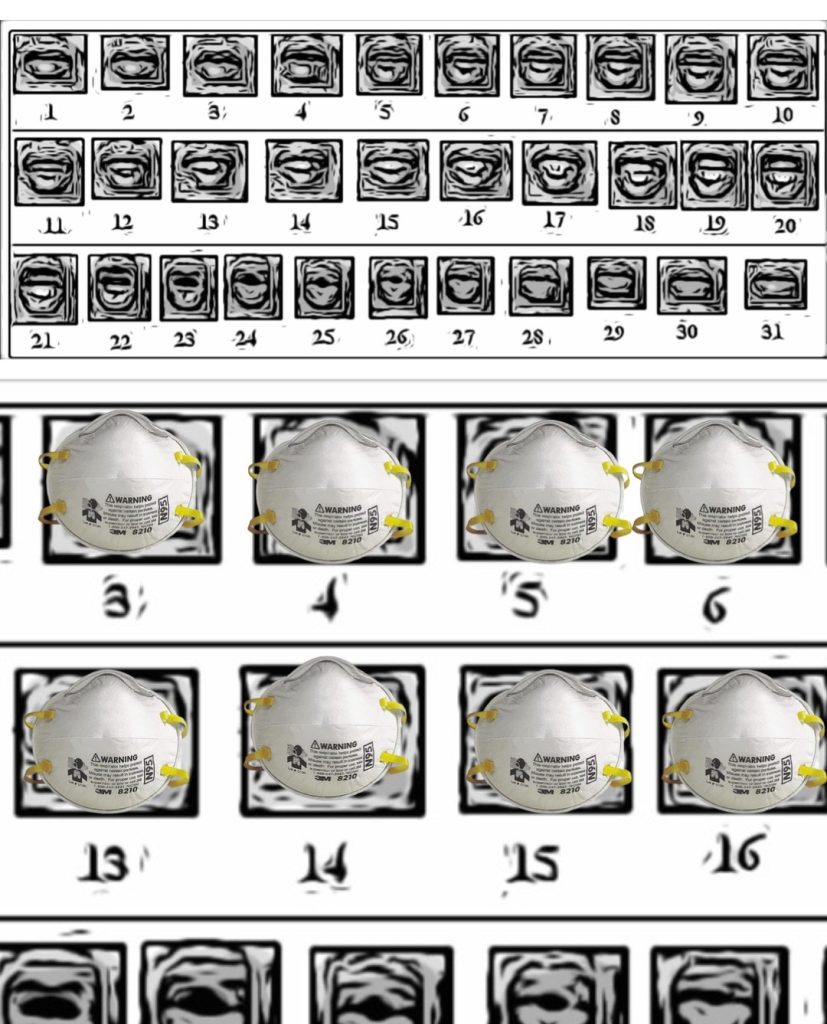
We break language into phonemes and visemes. Phonemes are sounds. Visemes are the visually distinct mouth shapes that produce them. English has 44 phonemes but far fewer visemes, because many sounds are differentiated inside the nose, throat, and tongue where you cannot see them. This is the ambiguity children exploit when they mouth “elephant shoes” to mean “I love you.”
Which is why pure lip-reading gets you no more than about a third of what’s said. But hard-of-hearing people aren’t purely lip-reading. We’re assembling a composite: the visemes we can see, the phonemes we can still hear, facial expression, body language, context, the slide behind the speaker. Each channel corroborates the others. Remove one and the rest have to carry more than they can.
Does obscuring the face meaningfully disadvantage hard-of-hearing people in our spaces? Are we choosing our disadvantage over that of the immunocompromised? Does the risk of respiratory illness outweigh the cost of not being able to understand each other? I don’t have clean answers to these questions. What frustrates me is that nobody is asking them.
III. The Disability Justice Framework
It is worth establishing what kind of argument this is, because it will be misread. Opposition to mask mandates has become a marker of right-wing politics: denialism, individualism, hostility to public health. This piece may share a conclusion with that tradition and nothing else.
The critique here is grounded in disability justice as developed by organizers including Mia Mingus and the collective Sins Invalid: that disabled people must not be an afterthought in movement spaces, that accessibility is not a favor but a floor, and that no policy is neutral. The question is always who bears its costs.
Disability justice asks us to move past what Mike Oliver called the charity model — in which a non-disabled majority graciously accommodates disabled people when convenient — toward genuine co-creation of spaces. Applied here, the question is not “can we accommodate Deaf and neurodivergent attendees under our mask policy” but “were Deaf and neurodivergent comrades in the room when this policy was written?”
The answer, in most cases, is no. These policies have generally been adopted by processes dominated by non-disabled voices, or by immunocompromised voices alone, framed as unambiguous collective care, and treated as beyond critique. And where hearing loss is considered at all, it is considered only for the Deaf and nearly deaf, not for the far larger group with partial loss who manage fine in daily life and are lost the moment a room fills with masked, echoing voices.
That is not disability justice, but a performance of it.
IV. What It Costs Deaf and Hard-of-Hearing Comrades
At a multi-day conference built on panels, workshops, caucuses, and hallway conversations, losing the visual channel is not just inconvenient, but can amount to exclusion from participation, distributed across every hour of the event.
The harm compounds for signers. Facial expression is not decoration in ASL; it is grammatically constitutive. Facial behaviors encode negation, questions, topic markers, aspect, and intensifiers. They are not an emotional overlay on top of signs but part of the morphosyntactic system itself. A masked environment doesn’t make signing harder. It makes it linguistically incomplete, in a way that has no analog in the hearing experience of masking.
The obvious reply is: provide captioning and interpreters. We should, always, and more than we currently do. But be honest about what that fixes. CART (communication access realtime translation) covers the plenary. It does not cover the hallway, the smoke break, the caucus that spills into a stairwell, the conversation over coffee where you find out who’s actually doing the work on a campaign you’ve been following. It does not cover the moment someone leans in and says something they wouldn’t say from a microphone.
Captioning gets a Deaf or hard-of-hearing comrade the content of the conference. It does not get them the conference.
When we build a space where comrades cannot fully follow a panel, cannot fully participate in a workshop, and cannot hold a complete conversation in the hall, we have built a space that is not for them. We have told them, through policy, that their presence matters less than the majority’s sense of safety. That is ableism. It does not become something else because we meant well.
V. What It Costs Neurodivergent Comrades
These harms are less visible, which makes them easier to dismiss and more important to name.
For many autistic people, prolonged mask-wearing involves real sensory processing difficulty. A 2022 multisite study found that pre-existing sensory-seeking traits predicted both difficulty wearing masks and impaired social communication among autistic children and adolescents. A 2024 qualitative study of autistic adults found that wearing masks and interacting with masked people created compounding difficulties across sensory, emotional, and communicative dimensions.
This confirms what autistic self-advocates said throughout the pandemic. The texture, the pressure, the heat, the altered breathing, these are not minor discomforts to be managed with willpower. For some people they make sustained presence in a room genuinely painful and eventually impossible.
And masking strips facial information from an environment where many neurodivergent comrades are already working harder than their peers to read the room. A multi-day conference is cognitively expensive under the best conditions. Obscuring faces removes supports people have spent years learning to use.
A mask exemption process addresses none of this. It requires a comrade to out themselves, justify their needs to an authority, and navigate a bureaucracy while already managing the demands of attendance. An exemption is not an accommodation. It is an obstacle installed to placate critics. It further stigmatizes the exempt attendees, rather than making them feel welcome.
Is that collective care?
VI. What Masks Do (and Don’t Do)
The COVID landscape keeps moving, and we should move with it. Rather than print numbers that will be stale before this zine is stapled, I’d point you to the CDC’s Respiratory Illnesses Data Channel and ask you to check it yourself before your next event.
I’ll name the awkward part directly: as I write, a summer wave is building. Cases are climbing. I am arguing for relaxing a policy while transmission rises, and I don’t want to slide past that.
Here is why I think it holds anyway. Severity is the variable that should govern policy, and severity is not tracking 2021. Hospitalization rates have fallen substantially from the earlier waves that produced our current norms. That does not mean COVID is over. It means the threat model has changed, and a policy written for the acute emergency of 2021 should not still be running on autopilot in 2026. As socialists, when the material conditions change, our tactics should adapt.
On the masks themselves: the meta-analytic evidence for respirator effectiveness comes overwhelmingly from healthcare settings with sustained exposure, trained users, fit-tested equipment, consistent wear. A conference hall is not a hospital ward. Marx, Engels, and Lenin would all fail a fit test on facial hair alone. Attendees pull masks down to eat, to drink, to be understood. Compliance is uneven by design. The conditions under which respirators demonstrably protect people do not describe a multi-day activist gathering.
I should also name the strongest argument on the other side, because it is a disability justice argument too: long COVID is disabling, and every infection is a chance to create new disability. That is real, and it is why “just let people choose” is not a sufficient answer. But it argues for reducing transmission through ventilation, air quality, and spatial design not specifically for the one intervention that works least well in this setting and costs the most to a different group of disabled comrades.
None of this means COVID isn’t real, that risk is zero, or that vulnerable comrades have no legitimate interest in protection. It means the blanket mandate has not been shown to deliver what its proponents assume in this specific context, and that this matters enormously when it imposes documented harm on other disabled comrades.
VII. Why We Bother Gathering At All
There is a third cost, and it’s the one I think we’ve been least willing to look at.
We can hold panels on Zoom. We can share documents, run trainings, take votes, and argue about the line without anyone buying a plane ticket. What we cannot do remotely is the thing that makes an in-person convention worth its enormous cost: recognizing each other. Knowing faces. Building the accumulated familiarity that lets a community notice who has been around, who vouches for whom, and who is new and needs to be brought into the fold. That recognition is the substrate of every trust network we have, and it is built by seeing people over time.
A conference where nobody can see anyone’s face is a Zoom call you paid airfare for. If we’ve decided that the in-person gathering is worth the money, the carbon, and the days away from work, then we should be honest that we’re stripping out most of what we came for.
VIII. A Path Forward
None of the foregoing is an argument against caring about transmission, supporting immunocompromised comrades, or taking collective health seriously. It is an argument against one policy instrument.
- Start with transparency.
- Organizers should be able to state the specific threat model the policy addresses, the reasoning that masking in this setting addresses it, and the process by which the full range of disabled comrades was included in designing it. If that account can’t be given, the policy shouldn’t stand in its current form.
- Move the burden into the building.
- Ventilation and air quality standards for the venue. CO₂ monitoring as a proxy for air exchange. Outdoor or high-ventilation space for high-density gatherings. These protect everyone without selectively excluding anyone. Where masks are used, use clear masks.
- Make accommodation actually accessible.
- Not an exemption process requiring disclosure and paperwork, but a clearly communicated norm: people who cannot wear masks, for any reason, don’t, without documentation, justification, or stigma.
- Create masked space rather than masked events.
- Designated areas where masking is the norm, for immunocompromised comrades who want that protection — chosen and controlled by those comrades, not imposed on everyone.
- And begin again,
- With all of us at the table, making policy together rather than seeking accommodation inside a policy made without us.
X. Conclusion
A conference that tells Deaf comrades they cannot fully participate, and tells neurodivergent comrades their sensory needs are secondary, is reproducing the hierarchies it exists to oppose.
This debate will be uncomfortable. It will be misread by some as an attack on collective care. It should be received as something else: as a demand that collective care be real, that it accounts for all of us, and that we hold our own policies to the same materialist standard we apply to everything else.
We can do better than this, and we owe each other the attempt.
Further Reading
Auer, Edward T., and Lynne E. Bernstein. “Enhanced Visual Speech Perception in Individuals with Early-Onset Hearing Impairment.” Journal of Speech, Language, and Hearing Research 50, no. 5 (2007): 1157–1165.
Clegg, Anna, Jade Wood, Hannah Hobson, and Felicity Sedgewick. “The Experiences of Autistic People When Facemask Wearing and Interacting with Masked Individuals.” Autism in Adulthood 6, no. 3 (2024): 285–296.
Graves, A. M., et al. “N95 Respirator and Surgical Mask Effectiveness Against Respiratory Viral Illnesses in the Healthcare Setting: A Systematic Review and Meta-Analysis.” Open Forum Infectious Diseases 11, no. 3 (2024): ofae040.
Mingus, Mia. “Access Intimacy: The Missing Link.” Leaving Evidence, May 5, 2011.
National Institute on Deafness and Other Communication Disorders. “Quick Statistics About Hearing, Balance, & Dizziness.”
Oliver, Mike, and Colin Barnes. The New Politics of Disablement. Basingstoke: Palgrave Macmillan, 2012.
Sins Invalid. Skin, Tooth, and Bone: The Basis of Movement is Our People — A Disability Justice Primer. 2nd ed. Berkeley: Sins Invalid, 2019.
Tamon, Hiroki, et al. “Autistic Children and Adolescents with Frequent Restricted Interest and Repetitive Behavior Showed More Difficulty in Social Cognition During Mask-Wearing During the COVID-19 Pandemic: A Multisite Survey.” BMC Psychiatry 22, no. 1 (2022): 607.
Valli, Clayton, Ceil Lucas, Kristin J. Mulrooney, and Miako Villanueva. Linguistics of American Sign Language: An Introduction. 5th ed. Washington, DC: Gallaudet University Press, 2011.
U.S. Centers for Disease Control and Prevention. Respiratory Illnesses Data Channel. cdc.gov/respiratory-viruses/data
FAQ:
Q: Presenters don’t have to wear masks. What’s the big deal?
A: Presenters unmasking helps, and it’s better than nothing. But a conference isn’t a series of speeches. It’s the Q&A, the workshop where twelve people talk over each other, the caucus that spills into a stairwell, the smoke break where you find out about what’s working in other cities. If the presentations were the point, we’d have stayed on Zoom and saved the airfare.
Q: ASL translation is an accommodation that doesn’t conflict with masking.
A: Most of the hard-of-hearing community isn’t Deaf and doesn’t know sign language. Interpretation is essential and we should provide more of it. But it serves Deaf comrades, and most people with hearing loss aren’t Deaf and don’t sign. Roughly 15% of American adults report some trouble hearing; most manage fine in daily life, don’t identify as disabled, and would never think to request an interpreter. We’re the ones who quietly lose half of what’s said in a masked room and don’t say anything. Interpretation doesn’t reach us. That’s most of the affected population.
Q: Don’t clear masks fit and filter worse? Independent testing shows it.
A: It’s true. Clear masks where communicative benefit is highest, not universally, and paired with ventilation that lowers the stakes of the fit penalty. This is a real tradeoff.
Q: Long COVID can disable anyone. This protects you too.
A: Yes, it’s real and it’s a disability justice argument. However, the number in circulation predates vaccines and Omicron. It’s a risk and should be mitigated. It’s also not the only risk that should be weighed in these discussions.
Q: Isn’t prioritizing your access needs over the collective’s health individualist?
A: Immunocompromised, neurodivergent, and hard-of-hearing comrades all part of the collective. Defining the collective as “everyone-but-you” is how ableism has always worked.
Q: “You don’t advocate for clean air, far-UVC, or testing.
A: I do, and it’s most of what I’m asking for. Ventilation standards. CO₂ monitoring. Outdoor and high-ventilation space. Venue selection on air quality. My complaint isn’t that we’re doing too much about transmission, it’s that we’ve reached for the one measure that costs disabled comrades the most and done almost nothing about the building.
Q; Doesn’t this hand ammunition to the right?
A: Yes, someone will misquote me, but that’s not a sufficient reason for the left to refuse to examine its own policies. Our arguments are sounder when they’re stress tested among allies.
Q: Have you considered that you might be wrong?
A: About epidemiology, entirely possible. I’m a carpenter and an organizer, not an epidemiologist, and the evidence on masking in community settings is contested rather than settled in my favor. But the argument I’m actually making doesn’t depend on winning that. Even if masks work exactly as well as their strongest advocates claim, I asked for an accommodation through the proper channel and got no reply, not a denial, silence. That happened regardless of what the science says, and it’s what I most want changed.
Q: So what do you actually want?
A: I want people like me to be included and considered when we’re deciding policies that affect people like me, in our gatherings, in our workplaces, and in our government.